Several news outlets, including the Huffington Post, are singing the praises of Amanda Hocking. Hocking is a 26 year-old Minnesota woman who's made a very impressive chunk of change by selling her YA fantasy novels as ebooks and circumventing the New York publishing system.
The HuffPo article goes out of its way to paint Hocking as a triumphant figure. And in some ways she is--she gets to live out her dream. I'm happy for her, and I get that Hocking's narrative plays into a very American mythology: charge your own path and mountains of monies will rain down upon your head.
But I think these kind of articles are missing an important part of the story. Yes, Hocking's story is impressive but a) Stories like hers are extremely rare and b) it ignores one of the most important aspect of releasing a book: publishing something that doesn't suck. And many of the posts I've read mentioned that Hocking's books are in desperate need of an editor. And that's no slam against her--the first and second drafts of my stories probably read worse than hers. Which is why I write third and fourth drafts, and have the stories edited ruthlessly by people I trust.
Now don't get me wrong-- I can see the benefit of some self-publishing. Wil Wheaton is the literary equivalent of Radiohead, in the sense that he started his writing career with a publisher before selling his books directly to his fans. The thing is, most of us writers aren't Wheaton or Warren Ellis. And we're not releasing music or comic books, which were practically made for self-publishing (in fact, most comics pros I've talked with look at self publishing as a badge of honor.)
I can also see how writing can have fun and get new fans by supplementing their published work with self-published material. Heck, that's what I did with "Mural". I knew I had the attention of a few readers, and decided to share with them a short story that I'd had trouble publishing elsewhere.
One of the most insightful arguments made against self-publishing come from novelist and current "Superman" writer Chris Roberson. He said that he had been a huge advocate for self publishing novels. Roberson hired a well known artist to draw the cover and gathered some impressive blurbs...and ended up selling less than 40 copies. His dreams of self publishing were dampened by reality, and he eventually found fame by publishing with a smallish press that could edit, promote, and sell his book.
Assuming that thousands of people are dying to read your self-edited, self-published book seems unrealistic. Feel free to share a few stories via the Kindle. Just don't try to build a writing career out of it.
Tuesday, March 1, 2011


Thursday, January 13, 2011
Fall of Frost and Emotional Continuity
What really struck me about "Fall of Frost" was the novel's unconventional structure. Instead of following the chronological timeline most biographic novels take, Hall's book is presented as a series of short chapters that give us a glimpse into a frustrated, complicated life.
Non Frost scholars like myself will be amazed at the chaos, death and mental illness that plagued the great poet. The book at times feel similarly chaotic--we are hurled from a moment in Frost's early days, to a moment in the 1940s, to his time in Russia meeting Khrushchev and so on. So the real continuity is an emotional one; for example, one section lines up Frost becoming comfortable in his Massachusetts farm, then to him not daring to even glance at its dilapidated shape on a car ride over a decade later, then to "The Novelist" exploring the refurbished farm in 2004. We get to trace exactly how crucial moments (like the death of his fellow poet and friend Edward Thomas) echoed through the rest of his life.
The breadth of the novel is striking. Every thought coming from Frost feels true to his nature, and when we step outside of Frost's world (including a lovely, brief chapter focusing on Kennedy) the characterizations feel just as true. A fine, captivating book. I cannot wait to read more from this author.
Non Frost scholars like myself will be amazed at the chaos, death and mental illness that plagued the great poet. The book at times feel similarly chaotic--we are hurled from a moment in Frost's early days, to a moment in the 1940s, to his time in Russia meeting Khrushchev and so on. So the real continuity is an emotional one; for example, one section lines up Frost becoming comfortable in his Massachusetts farm, then to him not daring to even glance at its dilapidated shape on a car ride over a decade later, then to "The Novelist" exploring the refurbished farm in 2004. We get to trace exactly how crucial moments (like the death of his fellow poet and friend Edward Thomas) echoed through the rest of his life.
The breadth of the novel is striking. Every thought coming from Frost feels true to his nature, and when we step outside of Frost's world (including a lovely, brief chapter focusing on Kennedy) the characterizations feel just as true. A fine, captivating book. I cannot wait to read more from this author.
Monday, December 13, 2010
(REVIEWTIME) A Special Place: The Heart of a Dark Matter
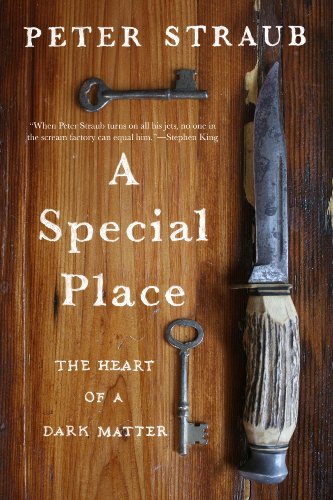
Just finished "A Special Place", a dark and engrossing novel by Peter Straub. Most seem to know Straub as "that guy who writes with Stephen King", but to me he has always met more. My interest in horror fiction waned in high school and I became enticed by the nerdy, literary paths paved by authors like Michael Chabon and Jonathan Lethem. Straub's bizarre, wild-eyed "Floating Dragon" dragged me back into the genre.
But therein lies the oddest aspect of Straub's career--for someone dubbed an "horror" writer by New York publishers and critics, he rarely delivers on the thrill-a-page promise of his book's blurbs and back matter. His stories brood and contemplate, and the scares are derived from the flaws and fiendish impluses of humanity, as opposed to more obvious supernatural threats.
Such is the case in "A Special Place". The novella, set in the late fifties and early sixties, introduces us to Keith Hayward, a young man who is obsessed and captivated by his uncle Tillman (nicknamed "Till"). A bond forms between the two for one simple reason: they both have an interest in extinguishing life. As Till's continued presence around Keith's home draws police attention, Keith's fascination with murder only deepens. The "special place" is both metaphorical (Till urges Keith to hide his dark interest from others) and literal (Keith eventually has to find a secluded area in which to act on his bloody instincts.)
Straub is a master at conveying emotion, and in this novella he pulls off something impressive; he makes us feel at least some compassion for murderers. Till is the envy of his family, a classy man who lives large and loves Hitchcock films. And Keith is a boy who, above all, wants to impress and protect his uncle. "A Special Place" is my favorite type of novella because it uses every page to explore its characters. The entire drive of the story is one child's attempts to realize their full potential and become true to themselves, like a crazed, Bizarro world Lifetime movie.
Saturday, September 4, 2010
Busy, busy. Here be dribs and drabs
* Currently balancing the following: two ongoing webcomic projects, sketching a very loose outline for a large prose project, and a ton of class assignments. Including three different online courses that I keep on getting confused.
* Very sad to see the Facebook boxes go away. I assume that they were a type of security risk for users (and taking cash away from the Mighty Facebook), since most Boxes were supported by other companies. That said, this probably means that my beloved Bookshelf, carefully maintained on Facebook for over a year, will go the way of Steve Guttenberg. So now I turn towards Goodreads...
* Finally saw Big Trouble in Little China
with a friend last night. Easily my second-favorite Carpenter film, behind "They Live". The film, for those who haven't already seen it, is basically a live-action comic book filled with crazy fight sequences, inventive monster designs, and a stellar smart-ass performance by Kurt Russell. Certainly worth a rental.
* Very sad to see the Facebook boxes go away. I assume that they were a type of security risk for users (and taking cash away from the Mighty Facebook), since most Boxes were supported by other companies. That said, this probably means that my beloved Bookshelf, carefully maintained on Facebook for over a year, will go the way of Steve Guttenberg. So now I turn towards Goodreads...
* Finally saw Big Trouble in Little China
with a friend last night. Easily my second-favorite Carpenter film, behind "They Live". The film, for those who haven't already seen it, is basically a live-action comic book filled with crazy fight sequences, inventive monster designs, and a stellar smart-ass performance by Kurt Russell. Certainly worth a rental.
Wednesday, July 28, 2010
Spine Breakers
I love listening to Spine Breakers . They cover books from all angles, from their love of libraries to the future of e-Books. Recently, they asked fans to shoot and submit videos about some of their favorite books. This is my entry:
Subscribe to:
Posts (Atom)